Dawn of the Dead (1978)
Last week's penultimate episode for season 3 of The Walking Dead featured a sly homage to George Romero - towards the end of the episode there was a zombie who was clearly made up and dressed identically to the iconic Airport Zombie (or Flannel Shirt Zombie) from the original 1978 version of Dawn of the Dead. I recognized it right away, because I am not ashamed to admit that Dawn of the Dead qualifies as my all-time favorite movie. Although Romero effectively invented the modern Zombie genre with 1968's Night of the Living Dead, it was the the sequel ten years later where he really left his mark. I have lost count of how many times I have seen this movie in all its permutations, but I can tell you that it occupies a significant chunk of shelf space in my living room with all of the different editions that have been released over the years. What is it about this movie that makes it work so well, and continue to be relevant 35 years later? Because at its heart it is really a very smart social commentary on American consumerism, wrapped into a compelling story featuring memorable characters and relationships. Yes, it is awash with violence and gore, but there is just oh so much more to this movie.
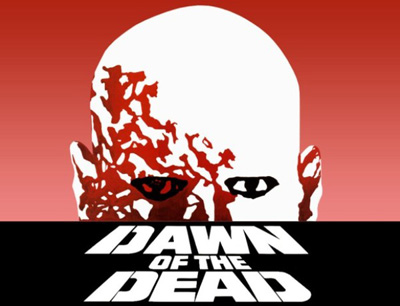
The movie has an easy enough elevator pitch - "zombies in a shopping mall" - but it really has quite a bit going on. It opens with a brilliant sequence in a television studio, where not only are you given an info-dump on the current state of the zombie uprising (bad, and getting worse) but you are shown the behind-the-scenes chaos as the production studio is falling to pieces. Narratively speaking it is a very smart and compact bit of writing that manages to establish premise as well as introducing and establishing two of the primary characters for the movie in just a few short minutes. This sequence is counterpointed with another establishing scene as SWAT soldiers try to establish order in an infested urban apartment building. The other two lead characters are introduced, and the story very efficiently provides both a fair amount of action to keep things moving while also giving some excellent character beats. As our four leads come together and escape the urban nightmare in a helicopter, Romero then brilliantly juxtaposes the horror of the densely populated city with the party atmosphere of the countryside with good-old-boys cheerfully drinking beer and taking pot shots at zombies wandering across the field. Without any dialog, the revulsion is plain to see on the protagonists' faces as they fly over the scene -- as horrible as it was to witness the collapse of the urban center, it is equally horrifying to see just how gleefully people are embracing this opportunity for mayhem and unbridled bloodshed. No matter which why they turn, the world is falling to pieces and there appears to be no safe haven.
After a brief refueling stop at a small airstrip, the characters finally arrive at the Munroeville mall and the main plot gets cranking. There is plenty of action as our heroes realize they can actually secure the mall, and that action is very well executed and varied. But again, it is the character interactions that make this such a rich story. Fran is a strong female lead who is increasingly frustrated as she is rendered powerless by the men (to be sure, with no malice, but they treat her like a girl). Her boyfriend Stephen, who began as a mild-mannered helicopter pilot, becomes increasingly sucked into the machismo of their two soldier companions, and it is his desire to be an action hero coupled with his rank inexperience that drives much of the movie's climax. Wild card Roger sparks with energy as the driving force to secure and clean out their new home, and the dramatic core to the middle act of the movie. The stable core that holds the group together is the stoic and dependable Peter, who delivers the memorable line, "When there's no more room in hell, the dead will walk the earth."
There is just so much that goes right with the execution of this movie. The characters are vividly drawn with rock-solid acting; the action set-pieces are perfectly executed; the original music by Goblin is iconic, and equally so the canned public domain music used inside the shopping mall is perfectly absurd. The social commentary is biting and accurate, and still holds up nearly four decades later. Truly this is George Romero at the height of his power, making the absolute best use of limited resources to create a compelling story that transcends genre and stands as a monument to the power of independent film-making.
If you have never seen it, please be aware that the movie exists in three different versions. There is the original theatrical version, the extended director's cut, and then Dario Argento's European cut that runs significantly shorter. Each version has its merits, but if you were to pick one I would highly recommended the director's cut. It gives the characters plenty of room to breathe, and for me the middle section is vitally important with it's quiet lull and exploration of the character's boredom and despair before the finale kicks into high gear. That being said, the shorter Argento cut really works very well on its own terms, and features many alternate takes and a very different musical score. I would honestly give this movie six stars out of five, it is the zombie movie that every other zombie movie strives to equal and invariably fails.
1 comment
Comments are closed. These were left by readers when the post was published.
silentalbino April 3, 2013
I caught this late one night after coming home from work and it totally freaked me out. Amazing film.