Nausicaä of the Valley of the Wind (風の谷のナウシカ Kaze no Tani no Naushika)
First off, before I get into this week’s post I want to say, I have no intention of turning this into an anime blog. My posts from the last two weeks led me back to Nausicaä, on which I will spend this week and next, but after that I will move onto other apocalyptic genres. Specifically I the coming weeks I have lined up posts on killer meteors, zombies, and all kinds of other non-animated mayhem.
So, why Nausicaä this week and what does it have to do with apocalyptic fiction? Well, re-watching Angel’s Egg led me back to the first Japanese animated film that really captured my imagination, and it is set in a future shaped by an apocalyptic war so it definitely fits the bill. Released in 1984, Nausicaä of the Valley of the Wind is set one thousand years after the “Seven Days of Fire” in which most of humanity and civilization was destroyed. Only a brief bit of backstory is given, but the implication is that some nation or entity either created or summoned a group of Giant Warriors who laid waste to the world.
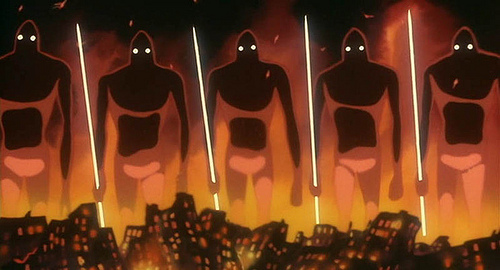
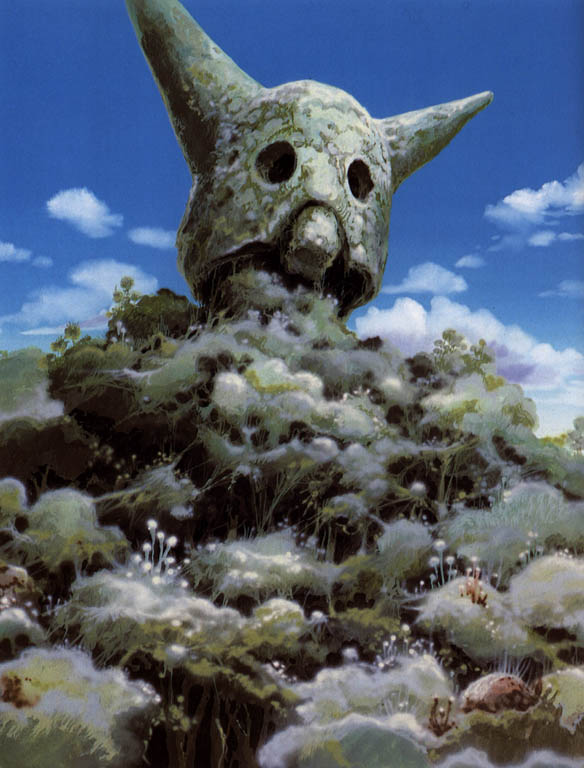
This is not a metaphorical interpretation of ancient history, with human descendants a millennia later mistaking a nuclear war for supernatural beings – very early in the film we see the fossilized remains of one of the Giant Warriors, and the driving plot for the second half of the movie is the attempted resurrection of one of the creatures.
In the wake of the Seven Days of Fire, not only was most of civilization obliterated but also the Earth’s ecology was dramatically altered. A giant fungal forest, called either the “Toxic Jungle” or the “Rotten Ocean” depending on the translation, has spread across the land. The spores from the toxic jungle are deadly to humans, who must wear breathing apparatus anywhere inside or near the jungle. Within the toxic jungle the insect life has grown to monstrous proportions, with flying insects larger than humans and in some cases as large as whales. Between the airborne nature of the fungal spores plus the flying insects to spread the spores even further, the toxic jungle has continued to expand and to bring humanity to the brink of extinction.
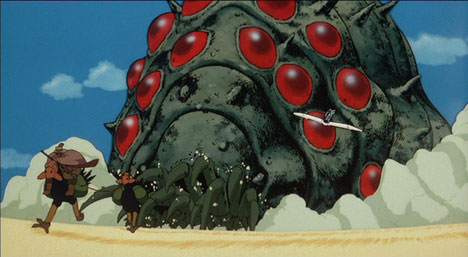
At the top of the insectoid population are the Ohmu, gigantic segmented creatures who rule the toxic jungle and who also appear to have some form of sentience. The Ohmu have two rows of eyes that are normally blue, but which turn to a vibrant red when they become angered. And believe me, you do not want to be anywhere near (or especially in front of) an angered Ohmu…
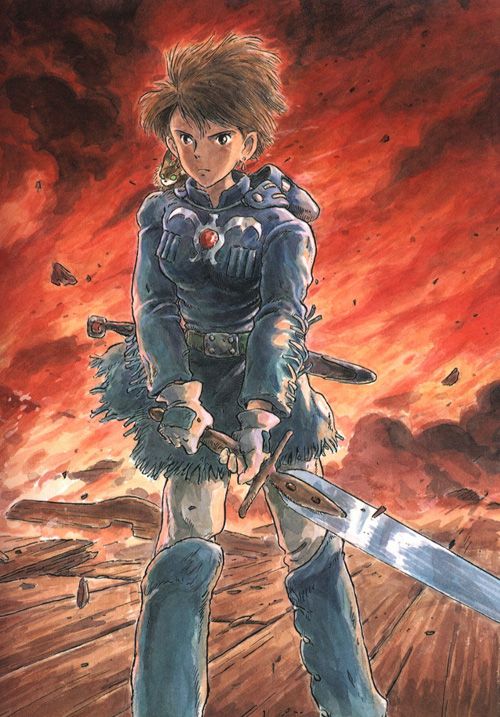
Against this backdrop we are introduced to the title character, Nausicaä, a young woman (and princess) from the peaceful Valley of the Wind. Her people eke out an agrarian living in a small valley that has thus far remained uninfected by the toxic jungle. As we see early on, this is not coincidental – the people of the valley work very hard to proactively seek out and destroy any fungal spores that reach their valley and burn them out before they can establish a foothold. Although the buildings and the daily life are reminiscent of what you might expect from a medieval village, the humans do still maintain some level of technology. Nausicaä has a powered glider vehicle that she uses throughout the story, and we see several other powered aircraft and vehicles used by other nations as well. Still, the people of the valley live very closely in tune with the land and the wind, and Nausicaä herself is particularly attuned to nature and the living world around her. Of course, when she gets mad she is also someone you really don’t want to tangle with.
The main conflict of the movie comes when an aircraft from the nearby nation of Tolmekia crashes in the valley, bringing with it not only spores and insects from the toxic jungle but also entangling the valley in the ongoing war between Tolmekia and Pejite. The valley becomes occupied by a military force from Tolmekia, who then move forward with a plot to resurrect an actual Giant Warrior.
At its heart, Nausicaä of the Valley of the Wind becomes a grand ecological statement as the true nature of the toxic jungle is revealed, and some of the nature of the giant Ohmu is revealed as well. The film has plenty of action and spectacle, but it is really all about the characters themselves. Even the primary antagonist Kushana is given moments of very revealing humanity – in particular I am thinking of a scene in which she reveals that the golden armor she wears is not simply armor but actually to some degree a prosthetic. She strongly hints at the extensive scarring her armor conceals, and comments on just how revolted any possible future husband will be.
Beyond the power of the movie itself, Nausicaä of the Valley of the Wind is also noteworthy as being the prototypical Studio Ghibli film. After the success of Nausicaä, legendary writer/director Hayao Miyazaki created Studio Ghibli which has gone on to make a long string of amazing animated films such as Princess Mononoke and Spirited Away. All of the elements that have become the trademarks of Studio Ghibli, you can see those same elements in Nausicaä. The level of quality and craftsmanship, both in animation and storytelling, is rivaled in the United States only by Pixar. The strong and telling difference is that while Pixar makes amazing family films that also play well to adults, Miyazaki makes amazingly complex and mature films that oftentimes also play well to families (although seriously, if you have kids, don’t be showing them Princess Mononoke…).
Even if you are not generally a fan of Japanese animated films, I strongly encourage you to check this one out. It is far more complex and engaging than you might expect, and it does not have any of the J-Pop clichés that might turn you off from anime in general. The more recent American release on home video is truly excellent, both with the English dub and when watched in the original Japanese with English subtitles. I just recently watched it again, and 27 years on this movie still looks excellent had has not shown its age at all. It is every bit as engaging and entertaining as it was the day it was released. Do yourself a favor and check it out if you have never seen it. You will not be disappointed.
Comments
Comments are closed. No comments were left on this post.