"No Flesh Shall Be Spared" - Hardware
“…ye shall hear of wars and rumours of wars…For nation shall rise against nation, and kingdom against kingdom: and there shall be earthquakes in divers places, and there shall be famines and troubles: these are the beginnings of sorrows…Now the brother shall betray the brother to death, and the father the son; and children shall rise up against their parents, and shall cause them to be put to death…No flesh shall be spared…”
- Mark 13:7,8,12,20
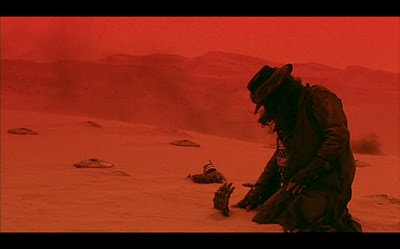
In September of 1990 a nasty little British film came out that was equal parts post-apocalyptic, science fiction, and horror. Hardware is a bleak, grimy, operatic and ultimately bloody and painful piece of work, and achieves all of its goals beautifully. From the opening sequence with the enigmatic Nomad trudging through the crimson dustbowl of a wasteland and discovering the remains of a battle robot, through the hypnotically violet climax inside the claustrophobic slum-fortress-turned-prison, this movie engages your senses at every level. It is certainly not for the squeamish. When I stumbled out of the movie theater in the fall of ‘90, I remember thinking to myself, “THIS is the kind of movie Clive Barker would make, if he was into science fiction…”
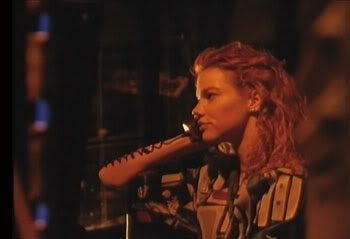
The film stars a very young Dylan McDermott as Moses (or Mo for short), a soldier just returning from duty on Christmas Eve, and who buys the robotic head from the Nomad to give to his artist girlfriend as a gift. Jill, played by the very lovely (ok, smoking hot) Stacey Travis, is an artist who makes metal sculptures out of found materials and scrap. Jill has become a recluse, virtually never leaving her fortress of an apartment. The world outside has become largely a radio-active wasteland with industrial slums filled with scavengers and criminals, and Jill has retreated into her own safe world. Unfortunately, even before Mo arrives on her doorstep her safe little bubble is already being disturbed by a peeping tom, played with a slimy-disgusting brilliance by William Hootkins. Once the M.A.R.K.-13 robot begins reassembling itself, the tension steadily mounts and drives to a horrifying crescendo.
I really love the visual style of this movie, with its dusty, grimy vision of society in decay and its computer hardware that seems to be jury-rigged and held together with nothing but some copper wire and a little bit of hope. The soundtrack veers from a tasty dobro guitar riffing over the wastelands, to hard rock from artists like Iggy Pop, Ministry, and Public Image, Ltd, to opera at one point in a breathtakingly painful sequence as a character slowly dies while Rossini’s Stabat Mater swells to an operatic climax.
In another scene, which stayed with me for years, a character is tripping out on drugs and trying to fight their effects in order to save Jill, but he is trapped on the wrong side of a mechanical door that is rhythmically opening and closing. You can see the desperation on his face, as a part of himself wants to drift away with the drugs and just stare hypnotically at the door’s movements, while another part is frantically trying to keep it together and save his friend. That door does some pretty serious damage, btw, and everyone is covered in blood by the end of the movie.
The movie packs all kinds of sex-drugs-and-rock’n’roll goodness into a tight and claustrophobic 94 minutes. It has a kick-ass punk rock attitude, black-as-night humor, and solid acting through-and-through. In retrospect, it perfectly embodies the gonzo “take no prisonors” attitude of the classic British comic book series 2000AD (the comic magazine that brought us Judge Dredd). Which, as it turns out, was not a coincidence…
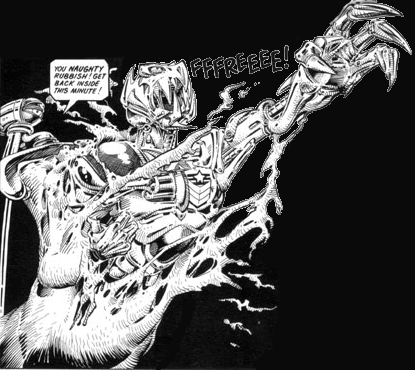
As it turns out, the entire story was lifted wholesale from the story “Shok! Walter’s Robo-Tale” by Steve MacManus and Kevin O’Neill, which ran in the Judge Dredd 1981 Annual. In the comic book (which you can read here, if you are interested), the robot head is a Shok Trooper recovered from the wastelands after the end of the Cursed Earth saga. The comic only runs seven pages, but on every single one of those pages you can see things that wound up directly in the movie. It’s not just similar, it has so many detail points in common that it is completely unmistakable as the original source of the story. Unfortunately, when the film first came out there was no credit given to 2000AD or MacManus and O’Neill. A court case followed in which MacManus and O’Neill succeeded in proving their story was the basis for Hardware. They were both given writing credits on the film, and all subsequent copies released on home video have properly listed them in the opening credits.
One last thing I should mention, being as this is a website dedicated to James Axler’s Deathlands series: Stacey Travis, the actress who plays Jill in Hardware, would have made an absolutely brilliant Krysty Wroth if there had been a Deathlands movie made around that time.
NEXT WEEK: Do you know your Enemy? (Hint: it’s zombies)
3 comments
Comments are closed. These were left by readers when the post was published.
Chuck September 1, 2011
I put on that soundtrack every time I start working up a Deathlands synopsis. "This is what you want, this is what you get. This is what you want, this is what you get. This is what you want . . ." You just close your eyes and take in the sodium yellow skies. Always liked that movie. They really made an effort.
labguy September 16, 2011
Thank you sir! I saw this film on Showtime or HBO many years ago. I have wanted a copy forever. Just could not remember the name!!! I just ordered Hardware on Blu-ray. Thank you again. In the words of Beldar Conehead, "I will enjoy it"!
Briley September 19, 2011
I finally got around to watching this on a dreary, rainy Sunday afternoon. I'm not so sure I agree with Ron's assessment that Stacey Travis would have made a good KW she seemed to wimp out at the end and only when the robot had it's Achilles’ heel snapped did she come back to show her wrath. The robot evidently wasn't programmed with detailed human anatomy for killing as the peeping tom, although getting what he deserved, needed a whole lotta overkill to do the job. The robot reminded me of the robot from Walter Koenig's Moontrap (1989) able to rebuild itself from junk. It was the technology of the time most likely.