Outlanders: Cosmic Rift
First off, a quick apology for the dearth of posts on this blog. Let's just say I had some stuff happening, and leave it at that. In my rebooting of PostApocalyptica, my intention is to return to a weekly post schedule and to always feature the current James Axler title when it comes out. Kicking things of is the latest Outlanders novel, released last November.
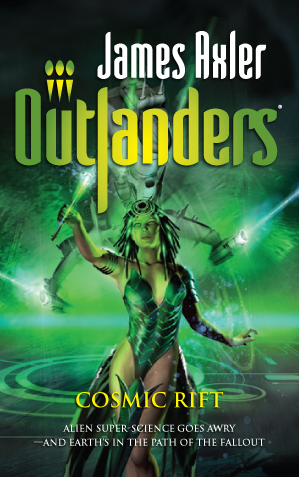
The latest entry by Rik Hoskin is a bit of an odd duck. That is not to say that it is a bad book by any means, it just takes a different approach than the usual High Adventure tone of the series.After a brief opening set during the Crusades, which does eventually come back to become relevant, the plot is kicked off with Domi being inadvertently kidnapped while on an away mission. In a bit of bad luck she is caught inside a recently-unearthed small spacecraft when it is carried off by a pair of unknown ships performing an apparent salvage operation. When Domi's transponder completely goes off the grid, the Cerberus team launches a very unorthodox plan to try to lure these unknown scavengers into the open. Of course the scheme works, leading Kane, Grant and Brigid to the hidden city of Authentiville -- a floating city hidden inside the titular Cosmic Rift. The balance of the book is spent inside this secret city which is ruled over by the seemingly-benevolent King Jack. What makes this book so odd is that, aside from the small bit of action at the beginning that tees off the plot, the vast majority of the book contains very little action. It is all about world building and introducing a new civilization to the mix. By the end there is a return to form with a potentially world-shattering threat to the Earth, but it is a long and strange road to get there.
One thing worth pointing out is that this story was clearly set up long in advance. There is a scene towards the end of Planet Hate, seven books ago, in which King Jack and his hidden city are mentioned in passing. One thing you can certainly say about Hoskin's tenure on Outlanders is that he clearly came to the series with a large number of ideas mapped out well in advance. That is most obvious in the whole Ullikummis grand story arc that recently concluded, but there have been other bits dropped here and there along the way. This is true not only of Outlanders, but in Deathlands as well where he has seamlessly and subtly dropped in bits of continuity and connective tissue between the two series that would be easy to miss if you aren't paying attention. These little details serve to create a welcome level of continuity, one that is sorely missing in Deathlands and which has always been central to Outlanders from day one.
Another thing I appreciate about Hoskin's writing is that he doesn't spoon-feed his readers. There are frequently ideas and allusions at play that he does not explicitly call attention to, but rather layers them in for the reader to intuit on their own. This can be a weakness at times, however. In the case of Cosmic Rift, it would be easy to read the book and think it strange that in all the years that Cerberus has been around they have never encountered the Authentiville scavengers before. In the same vein, Domi seems to act very out of character during the middle part of the book. Both of these issues are actually very well explained by the events and situations of the book (in the case of the former it is because of the nature of the HAPPENING device, in the case of the latter it is because of the GOD rod).
Speaking of which, there were a lot of clever acronyms in this story. The aforementioned HAPPENING device and GOD rod, as well as the DEVIL rod, the TITAN device, and a few others. They are not capitalized that way in the book, I am just writing them that way here to point them out. I was reminded of the pilot episode of Marvel's Agents of SHIELD in which a character is asked what he thinks about the agency's name, to which he replies, "It sounds like someone really wanted our name to spell out SHIELD...." I get that vibe here as well. The acronyms are not something that has come up heavily in Hoskin's prior entries into the series, but rather seem to be a particular cultural preference of Authentiville.
Getting back to the actual story, the thing I found most interesting (and there are some minor spoilers here, so tread lightly if you have not yet read the book) was that I had presumed that King Jack and Authentiville would turn out to be a malevolent force masquerading as a peaceful one. That turns out not to be the case, and King Jack really is the benevolent and laid back ruler that he appears to be. For centuries he has looked over his secret city and it's people, wishing only for peace and happiness. He scavenges the Earth for alien technology, and then harvests it not for war but rather to create technical marvels for his people to enjoy. In a thousand years, only one of his citizens has ever proven to be a hostile criminal. And of course, it is this person -- Wertham the Strange -- who proves to be the villain of the piece. The final act of the book contains virtually all of the action in the story as Wertham fires up the Doom Engine and unleashes the Titan device upon the Earth.
On the whole I did enjoy the book, although it is perhaps my least favorite story of the past few years. After the grandiose Ullikummis story arc and then the Judge Dredd pastiche of Sorrow Space and the steampunk goodness of Immortal Twilight, this book felt a little more like a prologue than a full story unto itself. It could remain just an oddity, or it may become one of those stories that only truly reveals itself in retrospect once the seeds that have been laid start to blossom. Time will tell.
Comments
Comments are closed. No comments were left on this post.