Outlanders: Judgment Plague
Generally speaking, the Outlanders series is best known for its high adventure story lines pitting a small group of human warriors against global, or sometimes cosmic, adversaries. Every now and then, though, a story comes along that is much more personal in nature. Although the titular menace has the potential for widespread mayhem (particularly in the mind of the story’s villain), the November 2014 Outlanders release Judgment Plague is pleasantly contained in its actual scope.
The story opens with a somewhat disorienting prologue featuring a squad of Cobaltville magistrates on an operation in the Outlands, set ten years in the past. The vignette manages to both introduce the key antagonist of the story, while also establishing the dual storyline that sets into motion the actions of the past that will mutate into the threats of the present. The setup makes full use of the axiom that the most interesting villain is actually the hero of his own story.
Without wasting time, the story leaps to an action-packed away mission by the Cerberus trio of Kane, Grant, and Brigid. While resolving the immediate threat that opens the story, the group quickly stumbles upon a human settlement destroyed by an unknown plague and then follows the threat back to its source.
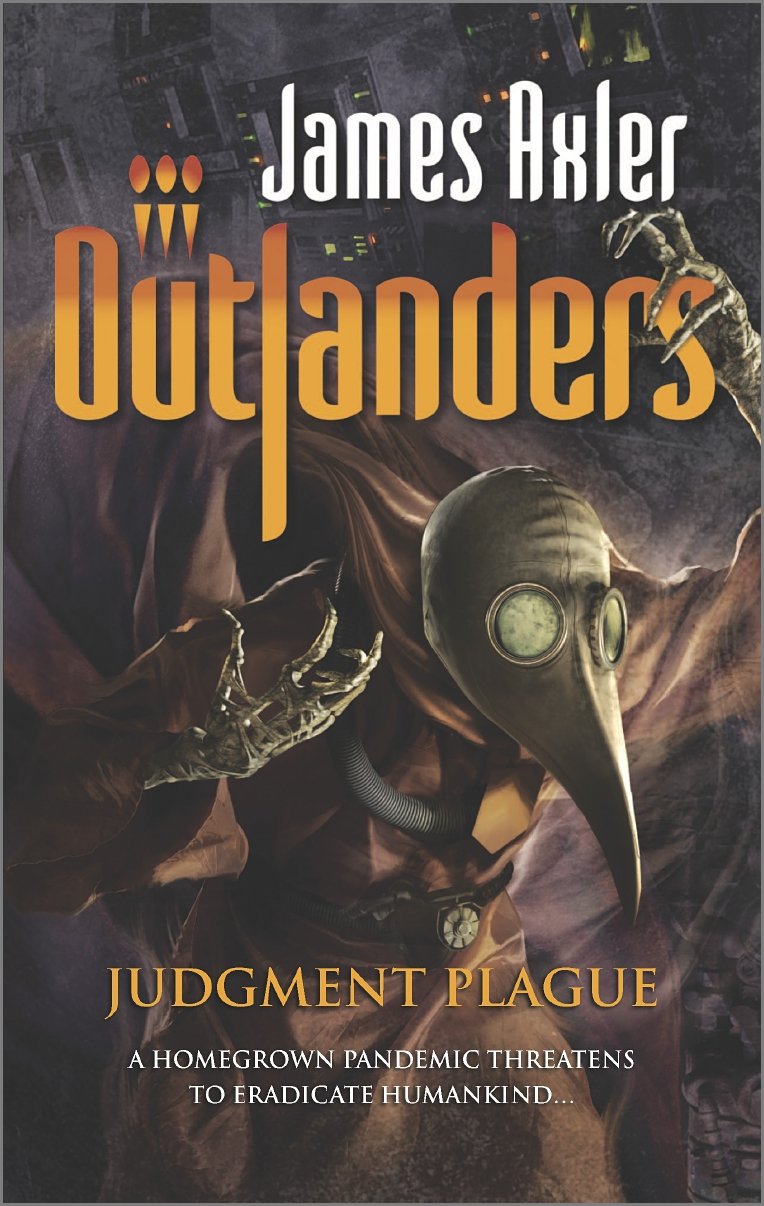
On a purely action-based level the book has plenty to offer, with rich and varied combat situations that chain together in a nearly breathless series of events. The nature of the villain, however, keeps the focus very tight. There is an unfolding mystery to this ex-Magistrate who now wears a full-bodied and armored containment suit with the visage of a crow. The imagery is not coincidental, given the mythological imagery of the Crow as both a harbinger and an avatar of vengeance and judgment upon the deserving. I also found some interesting, if unintentional, parallels between the antagonists attitudes and principals, as compared to the criticisms of some American police officers that have been making the news of late. Where our heroes (a.k.a. the “good cops”) embody the purest ideal of strength and justice in service to protect the innocent, our villain (a.k.a. the “bad cops”) embodies the worst and most cynical notion that everybody is guilty of something if you dig deep enough, and deserves whatever punishment they get.
There were two vignettes in the story that I particularly liked, one a brief encounter in the desert just outside of Cobaltville and then the second a little later within the city walls at an elevator bay. In both cases, Kane and Brigid are briefly distracted from their main objective by low-level criminals. Again in both cases, the criminals involved have no idea just how badly they have stepped in it. As much as I enjoyed the main storyline, it was the little things like that which gave the story a little extra spice.
On the whole I thought it was a good book, and a nice respite from the usual Earth-shattering threats. Those are great, but every once in a while it is good to have a nice, compact thriller. I am sure the big guns will come back out again in the next one.
Comments
Comments are closed. No comments were left on this post.