Tenshi no Tamago a.k.a Angel's Egg
Sit back, boys and girls, I’m going a bit surreal this week. This is one of my all-time favorite movies – beautiful, hypnotic, surreal, and cryptic all rolled up into a gorgeous anime package. I discovered Mamoru Oshii’s “Angel’s Egg” quite by accident back in early 1986, and therein lies a tale.

In early 1986 I attended Rustycon with my best friend Riff, and spent a fair amount of time in a room that was showing non-stop Japanese animated films. I got to talking to the guy who was running the room, and ultimately a few weeks later he gave me a videotape copy of Tezuka’s “Phoenix 2772”. As an afterthought, because there was space at the end of the tape, he also tossed in “Angel’s Egg” because he thought it was pretty cool. Twenty five years later and I can’t say that I have ever given Phoenix 2772 another thought, but “Angel’s Egg” has stuck with me.
At that point in time, Mamoru Oshii was best known for Urusai Yatsura. In later years he would be celebrated for Patlabor and Ghost in the Shell. In my opinion, his real master work is Angel’s Egg. Sadly, it is completely unavailable on home video, at least in the United States. I couldn’t even find a bootleg copy. I am sure it is out there somewhere as a bit torrent, and most of it can be found on YouTube, but if you want a high quality copy of the film on DVD or Blu-ray you are out of luck.
Plot-wise, the film is almost impossible to describe in any way that makes coherent sense. The best I can come up with to describe it is as a Shinto meditation on Christian mythology, most predominantly focused on the Deluge. In an abandoned ocean-side city a young girl spends her days collecting jars of water and protecting a large egg. A mysterious soldier appears, and slowly befriends her. And at one point the statues of the townsfolk come to life and hunt shadow-fish on the walls of the buildings. The end.
But oh, the imagery. The film opens with…. well, the film opens with a study of the young girl’s hands, which are gradually replaced with the soldier’s hands, which crack with a sound like the breaking of an eggshell. Then an image of a giant translucent egg being held aloft by a tree/vine thing, and inside the egg a bird lies sleeping and dreaming. And then the Eye of God appears.
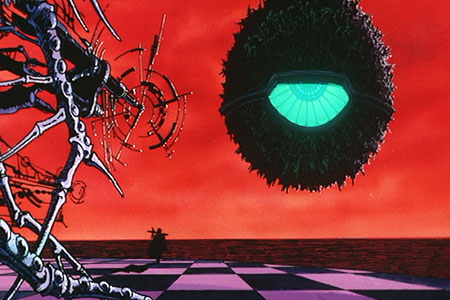
This strange craft descends from the sky, and in close up shots we see that what appears to be an eye is actually a giant stained glass window, and behind that window is row after row of statues of praying figures. The Eye of God descends into the ocean as the Soldier watches, and as steam-driven pipes and sirens sound an alarm. The alarm awakens the Girl, and from there we watch her proceed through her daily routine.
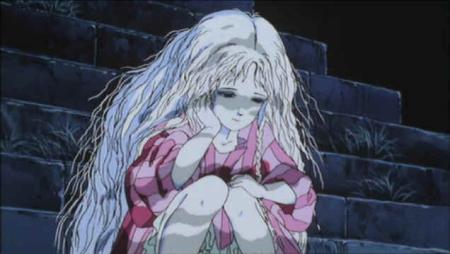
The Girl is young, clearly an image of innocence and beauty. As she awakes we see that she has kept a giant egg next to her under the blankets, to keep it warm. As she prepares to go out for the day she places the egg into the belly of her dress, creating the appearance of being very pregnant. The imagery is very clear – she is the Madonna, she is the virgin Mary, she is the Holy Mother of purity and innocence, carrying her unborn immaculately conceived child and protecting it from all danger.
She travels to the village with a glass jar, and proceeds to fill it with water. In the town she first encounters the Soldier, and the first line of dialogue is spoken.
“Who are you?”
That phrase is repeated again, but it will be the only dialogue spoken for the next 45 minutes.
And speaking of imagery, here is the Soldier:
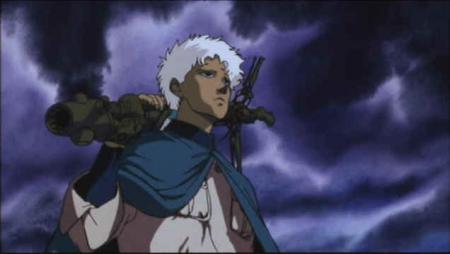
He is an obvious Christ figure, from the cross-shaped weapon he carries to his bandaged hands that imply a stigmata that we never see. He attempts to befriend the Girl, but she runs away in fear. It is during this section of the movie that she encounters the Shadow Fish. She is in the village hiding when the statues of fishermen come to life, and begin chasing the shadows of giant coelacanth swimming along the walls of the buildings.
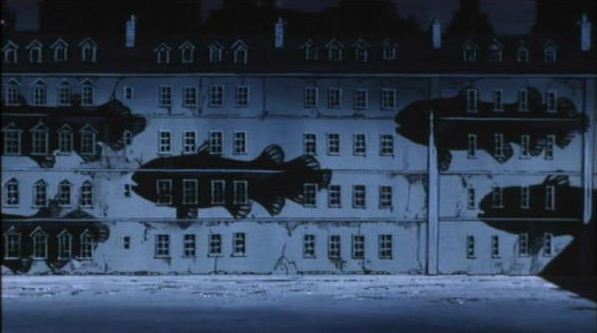
It is no coincidence that the specific fish used in this sequence are the infamous “living fossils”. The statues of the fishermen throw their harpoons at the shadow fish, but the shadows just drift away. The not-real men are unable to catch the not-real fish, and the very real little girl hides in fear.
Ultimately the Soldier does befriend the Girl, and he follows her to the cavernous stair-filled refuge where she apparently lives. As she sets down her glass jar of water you see the rows and rows of water jars from previous days, and you wonder for just how long has she been performing this task?
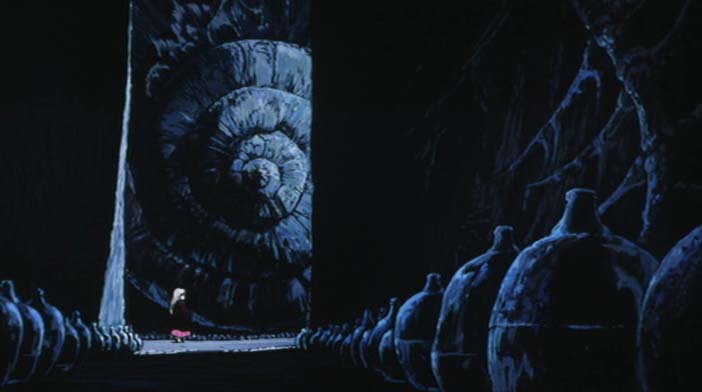
This cavern is also filled with fossils, among them what appears to be the fossilized remains of an angel. And in fact, there is the distinct feeling that the entire cavern is actually the belly of a great creature – a clear reference to the story of Jonah and the Whale. During this sequence comes the only lengthy bit of dialogue, in which the Soldier recounts a story that is largely referenced from Noah’s Ark.
Also in this section is a brilliant piece of animation. Already this has been an extremely meditative film with very little motion. There comes a scene in which the Girl goes to sleep as the Soldier watches over her. The image holds for what seems like several minutes, with the only motion being the flickering light of the fire as it slowly dies.
The climax of the film comes, and I won’t spoil that for you in the hopes that you will actually seek out this movie somehow and can experience it for yourself. It is simultaneously heartbreaking and beautiful. It is the final shot that really stays with you, though. The Soldier stands on the beach as the waves lap at the shore and as the feathers of birds unseen ruffle in the wind. The camera slowly pulls back, as we see more of the beach. And then at a certain distance we begin to see that the beach, and the entire land mass, appears to actually be the barnacle-encrusted underside of a capsized ship.
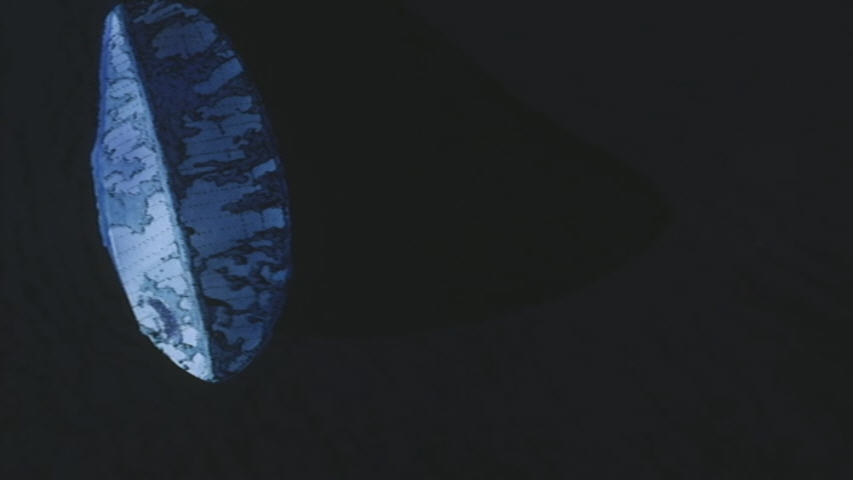
And again, as the camera pulls back even further, that ship begins to look like just another feather like the ones that were fluttering along the beach.
This is a bleak, minimalist film of perpetual twilight and very little dialogue. The world has been destroyed by floods, or perhaps the world is simply the dream of the Bird that lie sleeping in the opening sequence. Mankind has become nothing but gray statues that only live a half-life chasing the shadows of their past. There is just so, so much in this movie to ponder. It is a real jewel, and I hope that someday it will receive its due.
NEXT WEEK: Horrible Translations – In the Aftermath
Comments
Comments are closed. No comments were left on this post.