The War Game - Nuclear War Comes to Britain
In 1965, the powerful documentary filmmaker Peter Watkins made the amazing “Culloden” – a documentary about the 1746 Jacobite uprising, done in the style of the Vietnam War reporting being done at the time. The docudrama was widely praised and went on to win a BAFTA award for its innovative style. Following on that success, his next project was intended to be aired as a documentary special airing on the 20th anniversary of the Hiroshima bombing. The War Game was presented as a documentary detailing the events leading up to and then following a nuclear attack on Britain by the Soviet Union. Before it could be aired, however, it was pulled from release by the BBC because it was deemed “…too horrifying for the medium of broadcasting.”
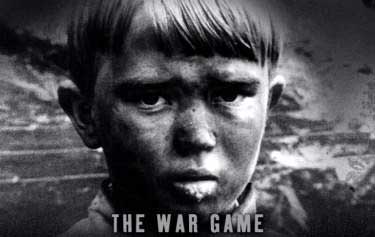
With a run time of not quite 50 minutes, this riveting faux-documentary is very brief in duration and yet all the more powerful because of it. It is a snapshot of society during the mid-60’s as the threat of nuclear war was nearing its peak. With only two decades having passed since the London Blitz, virtually every adult involved with this production had direct personal memories of life during and after warfare (something which American civilians such as myself have never experienced, and have a difficult time comprehending), and that experience comes through in a myriad of heartbreaking ways throughout the show.
Watkins almost exclusively uses amateurs in his productions rather than experienced actors, which lends an amazing sense of reality and despair to the proceedings. He starts by laying out the logistics involved with a full-scale evacuation during the run-up to war, with tens of thousands of women and children being relocated from urban centers into the surrounding countryside and with homeowners being compelled by the government to take in and care for these masses of people. When the first bombs fall the victims are given barely three minutes warning before the first nuclear flash. We are shown a young boy standing in his yard screaming and covering his face, while a dispassionate narrator describes the intensity of the flash and its ability to literally melt eyeballs in their sockets for anyone unfortunate enough to be looking in that direction.
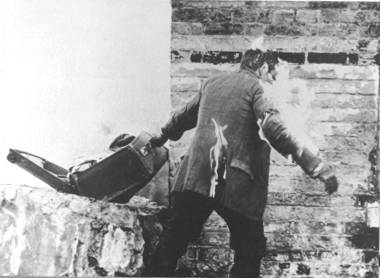
A few seconds after the flash comes the heat of the blast itself and the concurrent shockwave. Furniture and clothing spontaneously combust, and then the documentary moves into what I found to be the most riveting section – a blow-by-blow description of a true firestorm that grows in intensity as the buildings and structures feeding it collapse. Hundred mile an hour winds are sucked into the firestorm, drawing in more victims and spurring the heat even higher. For those not killed by the fire itself, we see them slowly collapse as the oxygen level is depleted and the methane and carbon dioxide levels increase.
Although fictional, The War Game is presented as a true documentary and remains every bit as powerful today as it was 47 years ago when it was originally filmed. Although the BBC did not air it (at least not until 1985), it won the Academy Award for Best Documentary Feature in 1966. In 2000 the British Film Institute created a list of the 100 Greatest British Television Programs, and The War Game was placed as #27 on that list. If you have Netfilx, it is currently available for streaming there and I heartily suggest you take an hour to watch it. It is is a moving, grueling 50 minutes of programming that I think will leave you stunned. Michael Bay and Jerry Bruckheimer can make all the big action spectacles they want, spend millions upon millions of dollars creating CGI porn of Los Angeles falling into the ocean, and they will never be able to touch the power of this little film shot with almost no budget on simple black and white celluloid. It really is that powerful, and I truly hope you will seek it out and give it a look.
Comments
Comments are closed. No comments were left on this post.